
By Laurie J. Beyranevand, et. al. - Vermont Law & Graduate School Center for Agriculture & Food Systems and Johns Hopkins Center for a Livable Future, May 2021
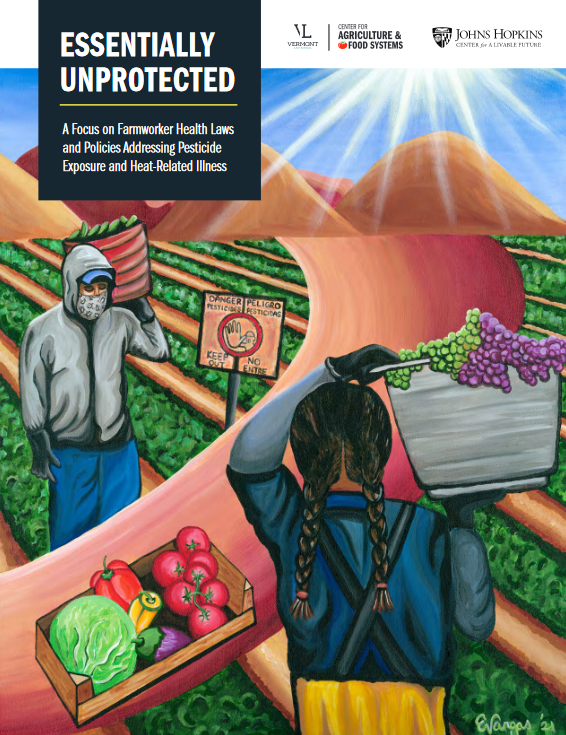 FARMWORKERS ARE THE FOUNDATION of a trillion-dollar industry in the United States yet face a level of occupational risk unrivaled by most workers. Despite their prominence within the nation’s food system, farmworkers are largely invisible to most Americans, as are their sacrifces and challenges. To some degree, the COVID-19 pandemic forced the country to reckon with the inhumane realities of food production; farmworkers were quickly deemed essential. At the same time, farmworkers contracted the coronavirus at high rates due to the lack of enforceable COVID safety standards, crowded and unsafe working and housing conditions, and delayed federal assistance. As our nation begins to reckon with its long history of pervasive and systemic racism, law- and policymakers must confront the fact that the vast majority of farmworkers are foreign born, identify as Hispanic or Latino/a, are not native English speakers, earn low wages, and have long worked under extraordinarily hazardous conditions. A smaller percentage of farmworkers identify as Indigenous with some identifying an Indigenous language as the one in which they are most comfortable speaking while some may speak a language without a consistent written form, which makes reading and writing in any language impossible. Over half of farmworkers are either undocumented or migrant workers thereby limiting their labor rights,10 as well as their willingness to exercise the limited rights they possess to report health and safety violations for fear of retaliation through immigration enforcement. Estimates suggest approximately 524,000 farmworkers are under the age of 18.
Farmworkers face many different workplace hazards including injury from heavy machinery and repetitive motion, and illness from exposure to zoonotic disease, pesticides, and heat. For migrant farmworker women, signi%cant reproductive health issues are common. Children working in agriculture amount to less than 5.5 percent of working children in the country yet suffered 52 percent of work-related fatalities. Additionally, farmworkers often lack access to or cannot a(ord healthcare both because they earn extraordinarily low wages and due to rampant wage theft. Understandably, they may be reluctant to raise workplace concerns with their employers due to fear of retaliation. Climate change has exacerbated some of these conditions due to extreme heat and increased pesticide usage to combat the rising spread of pests.
Download a copy of this publication here (PDF).