
Claim: The mass protests are being organized by the Democratic Parry and/or are another example of the Democrats “Sheepdogging” the masses back into the fold.
While it’s certainly true that some Democratic politicians participate in the organization of these events, and some were featured speakers, “Hands Off” and “No Kings” aren’t a Democratic Party organized event, nor are they specifically intended to promote the Democratic Party.
“Hands Off” and “No Kings” are, in fact, the confluence of several different and distinct organically organized movements and organizations, including Indivisibles, 50501, MoveOn, the Working Families Party, #TeslaTakedown, the Federal Unionist Network, various unions, some elements within DSA, and more, all of whom have been organizing a series of escalating protests and efforts independently of each other to target the fascistic Trump Administration and the Trump-Musk illegal and unconstitutional fascist coup.
While many of these organizations have some varying degree of alignment with the Democratic Party (mostly out of strategic pragmatism), none of them are being controlled by the Democratic Party or the Democratic National Committee (DNC) itself. The leaders of these organizations (in as much as they even have centralized leadership) do not take their marching orders from the Party, and many of them, including especially DSA, the Working Families Party and Indivisibles are harshly critical of it.
In the case of WFP, it is actually an independent party which pursues a “fusionist” approach. The WFP believes that there currently isn’t a large enough base of voters to support a completely independent left working-class party, and I generally agree (though, unlike WFP, I am agnostic on electoralism as a strategy at best). There are currently more than 500,000 contestable political offices in the US. Democratic Socialists of America (DSA) currently has approximately 100,000 members. In addition to the candidates, one must also organize a political machine in order to successfully win enough elections to achieve power.
While there is likely ideological support for a progressive alternative to the Democrats on this scale (especially if the support for Bernie Sanders is any indication), that support is still largely disorganized and needs time and effort to be built. It is far easier and more efficient, in many progressive people’s opinions at least, to pursue an inside-outside strategy rather than trying to build a new party from scratch or swamp an existing third party through mass entryism. Whether right or wrong, WFP has elected to pursue a fusionist course. While many on the left may disagree with that choice (and may have very convincing arguments for doing so), it is nevertheless incorrect to dismiss WFP as merely a “Democratic Party front”. The claims to the contrary have their roots in dogmatic Marxist sectarianism, particularly Stalinism, but also the more dogmatic strains of Leninism and Trotskyism, all of which tolerate no competition to their own doctrines and routinely dismiss competing theories and tendencies as being “counterrevolutionary”, a highly dubious notion at best.
DSA isn’t even as unambiguous as the WFP. There are many, not entirely aligned, though not entirely hostile factions within DSA with differing perspectives on the Democratic Party. Some advocate working entirely within the party and attempting to transform it into a socialist party; some advocate that as one prong among many, including building a socialist alternative to it in the long term; others oppose working within the Democratic Party at all, and push for a clean break from it (and within that particular faction, there are multiple, divergent views on the efficacy of mass protests, including “No Kings”); there are even DSA members who are anarchists and eschew electoralism entirely.
Meanwhile, Indivisibles was founded by two former Democratic Party Congressional staffers (Leah Greenberg and Ezra Levin) who are critical of the Democratic Party, and seek to make it more responsive to its voters, a process—if successful—would almost certainly necessitate a leftward shift, but also a more grassroots shift. This strategy mimics that of the Tea Party, with two exceptions:
- The Tea Party’s ideological stances were right wing and proto-fascist (though slightly less extreme than MAGA);
- Unlike the Tea Party, Indivisible is not largely astroturf, in that it is not funded by the capitalist class (even though some of the supporters and leaders of it, but by no means the majority, qualify as petit bourgeois capitalists).
In fact, Indivisibles is a fairly decentralized movement, with hundreds of local, largely autonomous chapters, with many of them recently formed (since Trump’s return to power). While many are indeed aligned with the Democratic Party in general, most of that skews towards the progressive wing of the party. For example, many California Indivisibles chapters have been steadily attempting to pressure Governor Gavin Newsom to take bolder positions on climate and have opposed what they believe to be concessions to fossil fuel capitalists. Nationally, Indivisibles have called for New York Senator Chuck Schumer to hand off the Senate Majority Leader role to someone else in the party as a result of his essentially capitulating on the budget fight in March (and they have reacted favorably to the news that Alexandria Ocasio-Cortez (AOC) could conceivably beat him in a primary election). Indeed, the organization’s founders describe their strategy as “shaping the opposition”. Whether that strategy is achievable or not (though there is some evidence that it actually has been to some extent, and could be more so if deepened), it’s clearly not what one does when following the party’s marching orders; in fact, it’s quite the opposite!
As for the other organizations, Move On was indeed started by two Berkeley residents who were (Bill) Clinton supporters (they were also the creators of the “After Dark” screensaver program for Windows desktop computers, i.e. the one with the “flying toasters”) in response to the Republicans making hay out of the Monica Lewinsky affair (which was a complete nothing burger), but it’s not officially connected to the Clintons in any meaningful way. #TeslaTakedown is a movement dedicated to a consumer boycott of anything financially connected to Elon Musk in response to the latter’s unconstitutional and dangerous coup (which constitutes one of the largest crimes of identity theft ever committed, to put it mildly). 50501 is an organic movement that was started by a handful of individuals on Reddit (though there’s some concern that it may have received seed money from campists. If that’s true, the latter are definitely not aligned with the centrist wing of the Democratic Party!) A whole litany of other organizations from DSA to the ACLU jumped on the bandwagon as the “Hands Off” and “No Kings” movement gained momentum.
What all of these organizations have in common is not fealty to the Democratic Party, but rather angry opposition to the advice, offered by James Carville, “that the Democrats should just play dead while the Trump administration shoots itself in the foot due to its own incompetence”. Such a strategy would constitute a strict electoral strategy with no energy focused on mass noncooperation or direct action. Carville is certainly correct that Trump and the sycophants surrounding him are largely incompetent at building their dystopian fascist order (such that they have been identified as the best organizers of the resistance that’s rising against them), but it’s a naive fantasy at best to operate under conditions typical in a normally functioning (bourgeois) democracy (and all of the organization being denounced as “liberal sheepdogs for the Democratic Party” all get this!). Trump, Musk, and the rest of the Project 2025 fascist Keystone Kops are incompetent, certainly, but they’re still causing an inordinate amount of damage to the administrative state (upon which many in the working class depend for survival needs) and engaging in brutality repressive tactics (such as attempting to disappear supporters of Palestine under almost nonexistent pretexts, shooting and murdering nonviolent protesters, or starting wars of choice, i.e. in Iran).
As for the accusation of “sheepdogging” (ie shepherding the millions of rank-and-file demonstrators “into (or back into) the Democratic Party”, which implies that these are essentially covert or overt Democratic Party operations to begin with), this implies that there is an organized left opposition to sheepdog them from. While there are certainly no small number of local or even small, albeit national, organizations and movements that exist outside and to the left of the Democratic Party (even to the left of Alexandria Ocasio-Cortez (AOC) and Bernie Sanders), and mass protests, mobilizations, and demonstrations that draw large numbers of people from these groups as well, including even a minority fraction of whom are aligned with the very critical leftists whose arguments I’m challenging here. While there’s actually no hard and fast line (despite what the sectarians claim) on what constitutes being aligned with the Democratic Party (which is, itself, not monolithic), it’s a pretty sure bet that the ecosystem of groups that are willing to work with the Democratic Party (or even merely encourage people to vote for its candidates out of strategic pragmatism), is far larger than those that are rigidly opposed to the idea (which is, itself, not a precise category either)[1], likely by a ratio of at least 100:1. In short, there’s absolutely no evidence that there exists an organized movement comparable to those with at least some relationship with the Democratic Party (with varying degrees of adversarial stances) at least not one capable of challenging it electorally, let alone replacing it.
There’s also little evidence to suggest that the vast majority of protesters attending these rallies aren’t either already registered Democratic (and had no intention of changing their registration) or aren’t registered as either Republican or Democratic (and have no intention of registering with either of those two parties). Some might even be registered as Republicans, and it’s much more conceivable that they might re-register as Democrats (or even a third party). Many will likely vote for the Democrats in the upcoming elections, because—when it comes to electoralism—it’s perceived by them as the least-worst option (however, that doesn’t automatically mean they won’t engage in other, far more effective forms of struggle outside the electoral arena, either, but more about that later…)
Several critics have pointed out that Democratic Party (and Democratic Party adjacent) politicians have been included among the featured speakers at some of the events. This is true, though it should be noted that many of the criticisms highlight the less progressive examples, even though the majority of those featured tend to be more progressive, leaning particularly on the direction of “the Squad” or Bernie Sanders. What’s often overlooked is that there are many that feature spokespersons significantly to these politicians’ left, politically, as well as union leaders, activists, immigrants, or private citizens. This is precisely what one expects to find in a popular front.
All-or-nothing sectarians will undoubtedly regard such fronts as merely fronts for the liberal wing of the establishment, arguing instead for a united front of strictly working-class organizations and people. However, it’s not so easy to strictly demarcate what is or isn’t precisely “working class”, and there’s no historical evidence to clearly prove that the latter is any more effective or less prone to reformism, Stalinism, or “sheepdogging”. One could also contrarily argue that it’s better to have (at least some) Democratic Party politicians, including unapologetically reformist ones, trying to ride the waves of popular dissent, because it demonstrates the power of the latter (after all, if they didn’t try, it’d likely signify that the protests aren’t impactful enough to bother with). Whether or not the politician successfully reins in that dissent depends mostly on the dissenters. There mere presence of a politician at such events, or even featuring them as a speaker, doesn’t in any way signify that they have any control over the mobilization at all.
While there may be some validity in arguing that these demonstrations would be more effective if they refused to allow these politicians a platform (or even invite them to speak), that has less utility than it might seem. For one thing, as I note below, there currently isn’t a viable, organized left electoral alternative to the Democratic Party that’s big enough or organized enough to win political power. Arguing that allowing Democratic Party candidates and politicians a platform forecloses on the possibility of that happening in the future is unconvincing, because there’s nothing, other than a lack of willing organizers, preventing the organization of such a party. It’s also the case that one could even allow for the dictum: “keep your friends close, but keep your enemies closer,” meaning that giving the politicians a platform carries with it the implicit understanding that any movement that can successfully turn out eight million protesters can fairly easily end that politician’s political career, if the latter makes themselves a political adversary.
Cynics will likely dismiss the likelihood of the protesters doing so, based on historical experience, but I wouldn’t be too quick to bank on that precedent holding. There’s ample evidence that the millions turning out to protest and resist Trump are quite dissatisfied with the current state of the Democratic Party. While polls that show Trump’s approval rating increasingly cratering (only competing with his first term for having the lowest approval rating of any sitting president), they also show the Democrats (generically, at least) have equally or even more abysmal approval ratings. The majority of these people—and, for that matter, the majority of Americans—based on issue-based polling consistently register opinions on just about every issue to the left of the Democratic Party’s stances. As for the majority of the organizations involved in organizing the protests, their views are similarly left of center and to the left of the mainstream Democrats.
The notion that these protests have served to release pressure and pacify public opinion doesn’t match the facts. If anything, as the protests have continued and grown in size, the majority of people have grown more, not less militant, demanding more from the Democratic Party. A “sheepdogging” operation run by the Democrats would almost certainly try to unify people around the party’s more traditionally centrist positions, but—as the rejection of Kamala Harris in the 2024 election revealed—those are insufficient to motivate a sizable enough majority of voters. And, anyone paying attention to the consensus opinions of the demonstrators or the organizations mobilizing them, the overwhelming majority agree that the Democratic Party couldn’t organize its way out of a paper bag in its current state.
Indeed, a perfect illustration of this can be given by debunking yet another sectarian left criticism of the organizations behind “No Kings”, and that’s the absurd notion that they’re Zionists (meaning uncritical of Israel). This is utterly false. DSA certainly isn’t. Working Families Party definitely isn’t. Ash Lee Henderson from WFP has written a lengthy social media post pushing back on the claims that Indivisible founders Leah Greenberg and Ezra Levin are[2] and 50501 has flatly denied it on their Bluesky page as well:
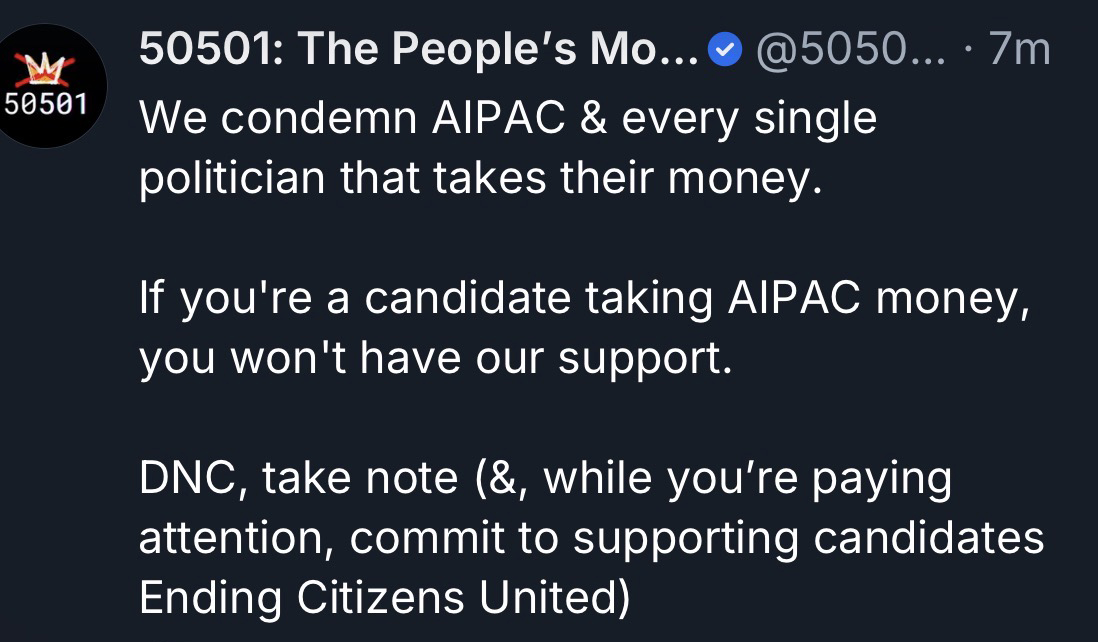
The fact that these organizations all flatly reject associations with AIPAC (who have been probably one of the most influential forces that shapes the opinions of the establishment Democrats, including establishing very clear boundaries on what is and isn’t politically permissible) should serve as demonstrative proof that the Democrats have not been pulling the strings behind “No Kings”. Indeed, the fact that AIPAC is losing support among elected Democrats, as well as the majority of the party’s base suggests that the opposite (i.e. that “No Kings” is succeeding in nudging the party leftwards) is at least partially true (Israel’s genocidal campaign in Gaza, their similarly destructive attacks on Lebanon, and their role in the war against Iran have played a substantial role as well).
There exists another definition of “sheepdogging”, of course, usually made by sectarian leftists who insist that such a descriptor applies to any attempt (no matter how small) to work with the Democratic Party on any level. Dogmatic Marxists and/or Marxist-Leninists insist that the label applies to anyone unwilling to completely break with the Democratic Party and instead explicitly work towards the organization of an independent, explicitly Marxian communist party. Meanwhile, dogmatic anarchists of most any tendency insist the label applies to anyone not eschewing electoralism altogether. Typically such all-or-nothing stances on voting for Democratic Party candidates (regardless of whether they lean right or left) corresponds to similar attitudes towards mass demonstrations, such as “No Kings”. I find both positions short sighted and self-defeating. Clearly, the overwhelming majority of people do so as well.
The biggest challenge in a complete “break” with the Democratic Party, of course, involves addressing the hard realities of an electoral system dominated by first-past-the-post-winner-takes-all voting. Such systems historically almost always result in the existence of two dominant parties, and the US is no exception. Historically, third parties (that eschew a fusionist approach, at least) in the US have always had limited success, either becoming dominant only if a preexisting party (such as the Whigs) implodes or having their ideas coopted by one of the already existing major parties if both are strong. Most progressive voters understand this intuitively, and because—since the early 20th century at least—the Democratic Party has been the (slightly) more progressive of the two, they have pragmatically chosen to work within that party (often begrudgingly), because, they believe, no better viable alternative exists in the moment.
To be certain, alternative parties exist. I, myself, have been a registered Green Party voter more or less since 1994. The problem is that these parties never amount to much, no matter how much those arguing for “a decisive break” from the Democratic Party champion them. That’s largely because the people willing to engage in the sheer level of work needed to make these alternative parties a viable alternative simply don’t (currently) exist, and that, in turn, largely because those clamoring for them seem quite unwilling to do the work necessary to manifest that mass organization themselves . The dogmatic third-party adherents either judge the existing third parties as insufficiently ideologically pure themselves, they think somebody else should do the work because they say so, or, they want the journey of building this party to be completed upon taking the first step.
Specifically, on this last point, the third-party champions demand that the party run its own ballot line-item candidates, often especially for President of the United States, and that anything less doesn’t constitute “a decisive break”. The disadvantage of such a strategy is that—given the fact that there are over 500,000 contestable elections in the US—it would require an organization at least three times larger to have any chance of fully taking power (and usually it requires a party machine at least ten times as large to actually win any meaningful number of votes[3]). Simply winning a few lower offices, or even the presidency, isn’t sufficient. It’s a Pyrrhic victory indeed to win a high-profile office and yet not having any power upon doing so (and simply winning “for impact” smacks of the very “performativeness” the sectarian critics accuse the mass protests of being!)
There are “third party” formations that do seek to function as an alternative to the Democratic Party, such as the Working Families Party, but within the context of working within the Democratic party, because they perceive that doing so avoids the aforementioned disadvantage. This allows the twofold option of either pushing the party leftwards (cooptation from below—something that the MAGA cult has essentially accomplished with the Republicans), or—failing that—breaking away if the party-within-the-party gains enough power and support. (In a sense, the WFP combined with others aligned with them have already reached this point, because more than 70% of surveyed Democratic voters desire the Party to shift leftwards politically). This is essentially the fusionist strategy.
The problem is that the sectarian left critics—at least those with a Marxist and/or Leninist orientation—denounce this strategy as essentially being “co-opted” by the Democrats. While this may ultimately prove to be true, there’s no hard and fast rule that says it must inevitably be so. If enough dedicated socialists transform the party from within (assuming enough socialists exist to do so), there’s nothing the anti-socialist gatekeepers could do to prevent it. In a sense, that is precisely what the MAGA forces have done to the Republicans from the right.
Now, some leftists will argue that these are apples-to-oranges comparisons, because the capitalist class supports (or at least enables) the far right take-over of the Republican Party (because it, at least partially, serves their class interests), but would not tolerate such a takeover of the Democratic Party. The problem with that argument is that it ignores the analyses laid out in Three Way Fight: Revolutionary Politics and Antifascism, which argues that fascism has its own internal logic distinct from capitalism (even though fascism is ultimately much closer to capitalism than socialism). The argument also ignores the fact that all people, and political tendencies for that matter, have agency. If a sizable enough mass organization of socialists chose to infiltrate and capture the Democratic (or Republican) party, it could be done. The real debate isn’t over the possibility, but rather the utility.
Meanwhile, as any anarchist will quickly point out, there’s nothing that guarantees that a “revolutionary (communist) workers’ party”, even one that conforms to Marxist-Leninist dogma, will remain true to the ideals of communism once in power, because the state has its own logic. Ultimately, a preexisting state, especially one oriented towards facilitation of a capitalist economy (as just about every bourgeois democracy is) is an organic amalgamation of social and economic relationships. Seizing control of the state apparatus itself doesn’t guarantee—and usually doesn’t involve—fundamentally changing those relationships (in fact, the record of such attempts is frankly abysmal, when one objectively looks at the historical records and factual data, stripped of ideologically revisionist bias). Grassroots organizing and strategic nonviolent tactics, on the other hand, usually do, however, and mass protests are one of the quickest and easiest (though admittedly not always necessarily or inevitably the most effective) methods for creating mass consciousness essentially needed to catalyze those changes.
I will now discuss why this is so in the next sections.
Footnotes:
[1] A group in this latter category might include those that actively promote alternative left parties, including encouraging voters to favor them, (e.g. the Green Party), non-electoralist organizations (such as the IWW, which leaves the individual choice to its members, but publicly argues that electoralism makes little appreciable difference—which means, in practice that a lot of members don’t vote in elections or just make pragmatic choices, including voting for Democratic politicians anyway as the least worst option), or leftist parties that don’t have the capacity to run their own candidates but still advocate for leftist alternatives to the Democratic Party. Within each group there are variations on what their members do, even within those with rigid, dogmatic stances on this (and other) issues. As Rebecca Solnit eloquently states it, “categories are leaky”.
[2] The post reads, in part: “Ezra and Leah are not Zionists. The rumor that they are is simply misinformation (from folks who saw and just didn’t know it’s not true) and disinformation (from folks who absolutely know it’s not true and are being intentionally malicious/wanna keep movement fighting each other).
Receipts:
- Indivisible came out for a ceasefire in October 2023.
- The founders are on the record calling Gaza a genocide and have an extended record of condemning the occupation.
- They are not Zionists and have a long record of being critical of Israel, AIPAC, and the weaponization of antisemitism in America.
- Leah serves on the board of the Diaspora Alliance, which advances the non/anti-Zionist definition of antisemitism.
- Their organization’s endorsement program explicitly bars candidates who receive AIPAC funding from consideration.
- All of the quotes being circulated to suggest that they are Zionist are clipped from communications in 2023 where they were trying to persuade their audiences to support a ceasefire.”
[3] As for building a party machine of at least ten times the size, 5,000,000 is approximately the number of those who turned out to the first No Kings protest. If the Green Party wanted to try and convince some of them to register for that party this would have been a start towards building such a political machine (and I’m certain Green Party members probably did attempt this), but it would require much greater, sustained effort to build this into a significant alternative to the Democratic Party. Blanket condemnations of mass demonstrations (especially in light of the fact that an overwhelming majority of whom who vote at all likely mostly vote for Democratic Party candidates) are not an especially effective means for doing so.
Last Updated - April 23, 2026.