
I assert that I have thoroughly debunked and disproven the arguments made by the sectarian left critics of mass mobilizations. Now I will offer my opinion on why I think these criticisms, many of which are boilerplate rhetoric that is often prewritten (and trotted out ad nauseum for every such mass mobilization), stubbornly persist in spite of the misconceptions they perpetuate.
I will grant that most of the claims are repeated (some might say, “regurgitated”) with honest intentions. By this, I mean that while they’re conveniently “prepackaged” arguments that are cliched and hackneyed (and all too readily available), there are myriad revolutionaries who repeat them (without fully grasping their origins) in more or less good faith because they honestly believe they’re making a salient, cogent criticism of the perceived limitations of what they deem to be “liberal” and/or “reformist” approaches (which they think includes most mass marches, protests, demonstrations, and mobilizations). What motivates them to utilize these all-too-readily available boilerplate arguments is often a lack of historical background, inexperience, naïveté, or frustration with the seemingly glacial progress (if any “progress” is unfolding at all) of change.
As someone with a revolutionary outlook, I sympathize especially with this last point, but in actual fact, much progress has been made, in no small measure due to popular uprisings and steadfast organizing, even though it often seems otherwise. That is partly due to the fact that revolutionaries use what could arguably be described as a very faulty metric of success. Much of the old, traditional Western left still holds fast to the notion that “the” revolution will be one, grand, final conflict, after which “the Internationale will be the human race.” Anything short of this constitutes a failure. This, too, is largely due to the romanticization of Marx and Lenin and the assumption that they had all the answers to everything (history says otherwise, however). In a very real sense, this romanticized revolution is analogous to a sports championship, in which the outcome of the game settles history for all time.
Reality is markedly different, however. What’s “revolutionary” today might actually be reactionary a century hence. For example, were you to invent a time machine and successfully transport yourself to the 1940s, you might be shocked to discover just how ignorant and unenlightened the revolutionary socialists of that time will seem to you on matters of energy, ecology, and industrialism (not to mention gender, misogyny, ableism, veganism, eugenics, indigenous sovereignty, and a whole range of other issues). While not monolithic, their perspectives might make today’s ecomodernists seem like primitivists by comparison. Meanwhile, they’d almost certainly find our views on such things to constitute some form of utopian infantile leftism and completely unrealistic.
The old left concept of the revolution as a one-off simply doesn’t square with either history or reality. In fact, revolution really just represents sudden spurts of evolution. Recognizing that truth doesn’t mean that revolutionaries are misguided in advocating revolutionary change. Quite the contrary; that pushing is essential in making those sudden spurts happen. Rebecca Solnit, Dávid Graeber, Mark Engler and Paul Engler, and many others have documented how this dynamic pervades our history. People typically organize around issues, and sometimes they win, either by dismantling systems of oppression and enshrining their newly won rights into existing bodies of law, or by changing societal norms so much so that those that oppose such changes in favor of previous norms lack the political and social power to turn back the clock. The ruling regimes may not actually change, but how they operate does. That’s not an argument for liberalism or passively assuming that evolution will take its course. Indeed, it’s an argument for continued revolutionary organizing.
What frustrates leftists, particularly old traditional leftists, is that this process is ongoing, yet inconsistent and nonlinear. There are ebbs and flows, fits and starts, and, yes, periods of rollback and backlash where progress is reversed (and that is usually the result of elites recovering from the shock of their power eroding, getting organized, and retrenching, but it’s also undoubtedly sometimes the result of revolutionaries overplaying their hands and alienating their base, such that conservative or even reactionary ideas can be legitimized, especially if organized reactionary groups are prepared to weaponize the cynicism of the masses). History is full of “three-steps-forward-two-steps-back”[1] changes. These dynamics are understandably very frustrating, and they breed pessimistic and cynical attitudes, particularly towards efforts to struggle against the regress or even insufficiently rapid enough progress. Wouldn’t it be nice if we could solve all of our problems in an instant? Boilerplate rhetoric provides conveniently available—albeit usually inaccurate—explanations that spare the critic of the uncomfortable work of self-reflection and soul searching that is often a necessary part of learning and growth.
But, if these are boilerplate rhetorical opinions (that are repeated in fits of ignorance or mental laziness by well meaning, but frustrated activists), who are the sources of them? I think the answer is pretty obvious: they are the product of dogmatic leftist organizations, some of which could arguably and accurately described as cults who are deeply threatened by the likelihood that these mass movements will rob them of a chance to recruit more followers. Either that, or they firmly believe in the vanguardist model of organizing, and they firmly believe that they are historically predestined to be that vanguard. Such attitudes are deeply ingrained in Leninist and/or Trotskyist doctrine, though there are a lot of roots for that in Marx’s and Engels’ source material. This explains why dogmatic leftism bears an uncanny resemblance to right wing religious fundamentalism.
One should also bear in mind the historical record of dogmatic vanguardist leftists once they acquire state power. It’s not particularly benign. Indeed, typically one of the three following things happens:
- They’ll govern as social democrats and enact social democratic reforms;
- They’ll eschew their radical positions and govern as neoliberals;
- They’ll govern as authoritarian state capitalists, and their positions will be not particularly distinct from fascism.
Alternatively, they’ll use two or all three of the aforementioned approaches at different times. There are precisely zero historical examples of dogmatic vanguardist leftists obtaining state power and subsequently dismantling said power structures and replacing them with bottom-up democratic socialism. Even if the desire and the intent to do so is there, the anti-authoritarian position (which is inclusive of, but not limited to, anarchism, i.e. libertarian socialism) is that this cannot be achieved through top-down methods. This was a very hard lesson the anarcho-syndicalists learned in the Spanish Revolution of 1936.[2]
Of course, it’s theoretically possible that in some imaginary future scenario, a vanguardist revolutionary group could obtain state power (through any number of means), with mass popular support, and faithfully transform the state and economy into a democratic paradise, but this has never happened historically, and it would be an absolute miracle if it did, for reasons I’ve already stated. That’s not to suggest that a left-wing politician cannot be elected and make a good faith effort to aggressively enact popular reforms; they almost certainly can. However, those reforms will be met with institutional resistance, roadblocks to their implementation, and aggressive propagandizing against them (in order to undermine popular support for them). With few exceptions[3], those who are critical of mass mobilizations due to the latter’s perceived lack of revolutionary acumen are likely to be just as harsh in their judgment of the elected official(s) attempting the popular reforms in good faith, because the reforms “don’t go far enough” or “aren’t being implemented swiftly enough”.
No matter what happens or who might be elected, regardless of their professed political positions, chances are good they won’t live up to all, or even most, of their promises and positions. Removing entrenched power blocs using state power is rarely easy or without peril. The general remedy in those circumstances is essentially the same as in the case of an authoritarian: popular, democratic pressure, manifested in a multitude of ways, depending on the specific case. That might include mass noncompliance, strikes, or mass demonstrations (like “No Kings”). The ability to wield power depends on the willingness of the people to allow it. And, yes, this means that the struggle to achieve “utopia” will be a never-ending quest, and one would do well to remember that this was Thomas More’s original intent in proposing it in the first place.
It is certainly true that some methods of resistance are more effective than others. The overwhelming historical evidence shows that nonviolent methods are more effective than violent alternatives. It is true that an organized working class, willing to engage in economic disruption, is a better defense against authoritarianism (as well as a more effective inducement to ensure that supposedly progressive elected officials honor their obligations) than not having one. This is a point that Erica Chenoweth, herself, has made: democratic states that experience authoritarian backsliding have a 50% chance of having that backsliding reversed if faced with mass nonviolent resistance. That percentage increases to approximately 83% if it includes active participation by organized labor.
Obviously, given the above, if there were general strikes called by the workers in response to authoritarian backsliding, or called proactively to push for progressive changes, they’d be highly effective, certainly more so than mere mass demonstrations. The problem is: the ability to do so requires far greater organization among the working class in most countries than currently exists. Certainly, we should be building that capacity (and most, if not all, of the organizations behind “No Kings” would heartily agree as this screenshot shows:
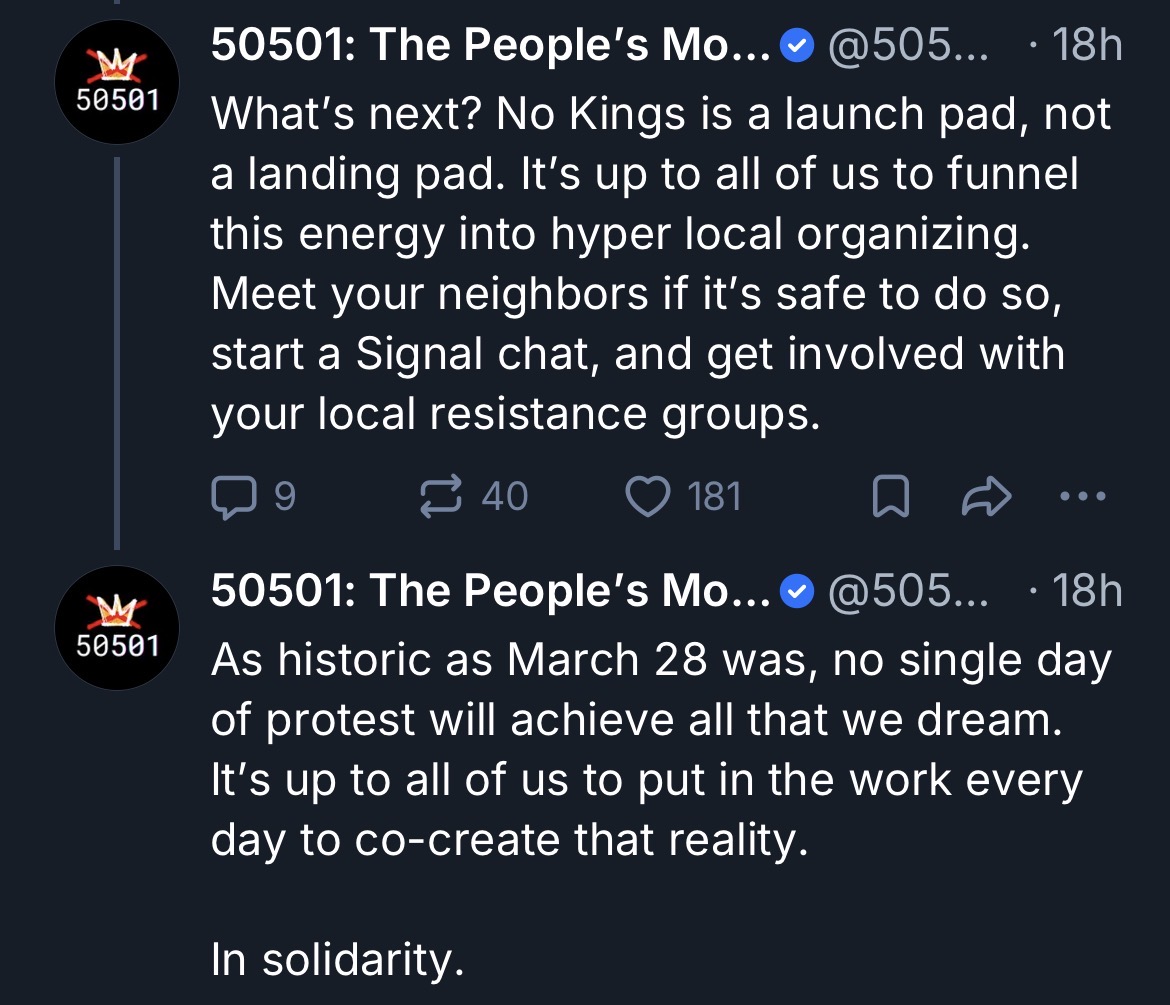
...but doing so is far more easily said than done. It requires sustained effort and time. It’s far too easy to proverbially rub the noses of those who cannot magically speak that capacity into existence (and don’t try to make the pretense that they can) in shit, and rarely do those that do actually make the effort.
Many of the critics will retort by arguing that “reformism” (by which they mean just about every method that doesn’t conform to their standards, whether it’s actually reformist or not), hasn’t worked in the past odd number of years. Genuine reformism probably hasn’t, as they say, but as I have previously argued, what constitutes “reformism” and what constitutes “transformative” (i.e. revolutionary) aren’t entirely solid categories with clear and unambiguous distinctions. It’s also true that during those same years, the purists have had ample opportunity to try and organize their alternatives. Have they done so?
The critics would earn more credibility if they could demonstrate the ability to mobilize equal or larger numbers of people to actually engage in their more ideologically pure, more militant efforts they’re evidently demanding. So far they’ve not done so. Like the old saying goes, “the proof is in the pudding.”[4] Likewise, these sectarian left critics would have more credibility if their own ideal alternatives had a better historical record than they actually do. Most so-called “communist” states have been anything but (indeed, most resemble the fascist authoritarianism and state capitalism that “No Kings” opposes). Most anarchist uprisings have failed to dismantle the state. The truth is that nobody has proven that they have an ideal, revolutionary solution, and it’s arrogant to denounce others as mere “liberal reformism” simply because they don’t follow some ideal model.
None of this guarantees that mass demonstrations, such as “No Kings” will live up to whatever revolutionary potential it may possess. Whether it does or doesn’t depends on the actions of those who participate. If it’s true (as it certainly is in specific cases) that the principal organizers of mass demonstrations have at least some reformist tendencies (though that is often dependent upon the body of rank and file demonstrators and their willingness to push for more radical demands), it’s probably more effective to participate in such efforts and push them in more revolutionary directions (as long as those “directions” aren’t merely following historically faulty paths). There are varying ways to do this, some more effective than others. A complete discussion on that is beyond the scope of this already lengthy treatise. I will say from experience, however, that one of the least effective ways to accomplish this involves attending organizing meetings and browbeating the organizers for their “counterrevolutionary running-dog lackey” tendencies.
That said, there are certainly salient and content critiques to be made of mass demonstrations generally, as well as specific such critiques to be made of mass mobilizations and popular uprisings. These critiques are often heard by the organizers. The latter sometimes respond to them and adjust their course accordingly, and sometimes they do not. Their willingness to do so likely depends on whether or not those making the criticisms have sufficient credibility. If the critiques are shared by a wide swath of those participating in them, the organizers are likely to listen to them (or else they won’t have a movement to organize!) Such critiques are likely to be taken more seriously by the majority of the participants if they’re based on factual information and made in good faith. Thus far, there’s been little evidence that any of the (sectarian) leftist critiques meet that standard. Indeed, they have been—to paraphrase Shakespeare—“a tale told by idiots, full of sound and fury, signifying nothing.”
Footnotes:
[1] I’ve lost count of how many times I’ve said this only to receive the response, “well, I feel like it’s ’one-step-forward-ten-steps-back!’”, and it’s always phrased that way, almost as if these responses are quoting some influencer that uttered such a quip. A close look at history will show just how wrongheaded that view—which is often that of those who are either inexperienced or have thoroughly unrealistic expectations of reality—is. There absolutely zero evidence to support the belief that public opinion and societal norms (on just about any issue you can name) have substantially regressed among the majority of people at all, let alone by that much. The perception is partly an illusion created by the fact that societal norms have shifted substantially leftwards (at least socially), but the modern state has not kept pace with that shift. The hyperbole in the response is really just a frustration with the hard truth that there is no scenario in which we’ll win a revolution that’ll settle history for all time, and then life will be a never-ending Bacchanalia. That’s a naïve fantasy. That’s not to suggest that everything everywhere inevitably gradually gets better; clearly it doesn’t, but things regress most quickly when people give in to cynicism and stop trying.
[2] There are some anarchists who insist otherwise, i.e. they believe that the FAI-CNT could have seized the state and instantaneously dissolved it by decree. I find this hypothetical scenario (which has never been tested historically) extremely unlikely, and the argument dubious. While dyed-in-the-wool anarchists would likely be more sincere in their dedication to doing so, simply issuing a decree that declares, “the State is hereby dissolved”, wouldn’t magically eliminate all of the existing social relationships that enable the hitherto existing state. Nor, for that matter, would such a decree eliminate all of the power blocs that might attempt seizure of the state through a (likely armed) coup.
[3] These exceptions usually involve cases where the politician in question is politically associated with the group making the exceptions, often for sycophantic reasons: e.g. the politician remains immensely popular (even though their attempts to enact popular reforms are being met with resistance), and the sycophantic group retains some benefit—such as name recognition which helps recruit new members or followers—from the continuing association. It’s unfortunate, but true, that there is no shortage of such political opportunism, and the so-called revolutionary “left” isn’t immune to it.
[4] I’m frequently amused that some critics will imply, if not outright argue, that the millions of people who attend these marches lack any revolutionary potential whatsoever. One is left wondering who they imagine might take their place (as if there is some vast untapped reserve of revolutionary working-class people who’d magically flock to the beck and call of the “right” revolutionary vanguard if it appeared).
Last Updated - April 23, 2026.